

Date: May 25, 2026
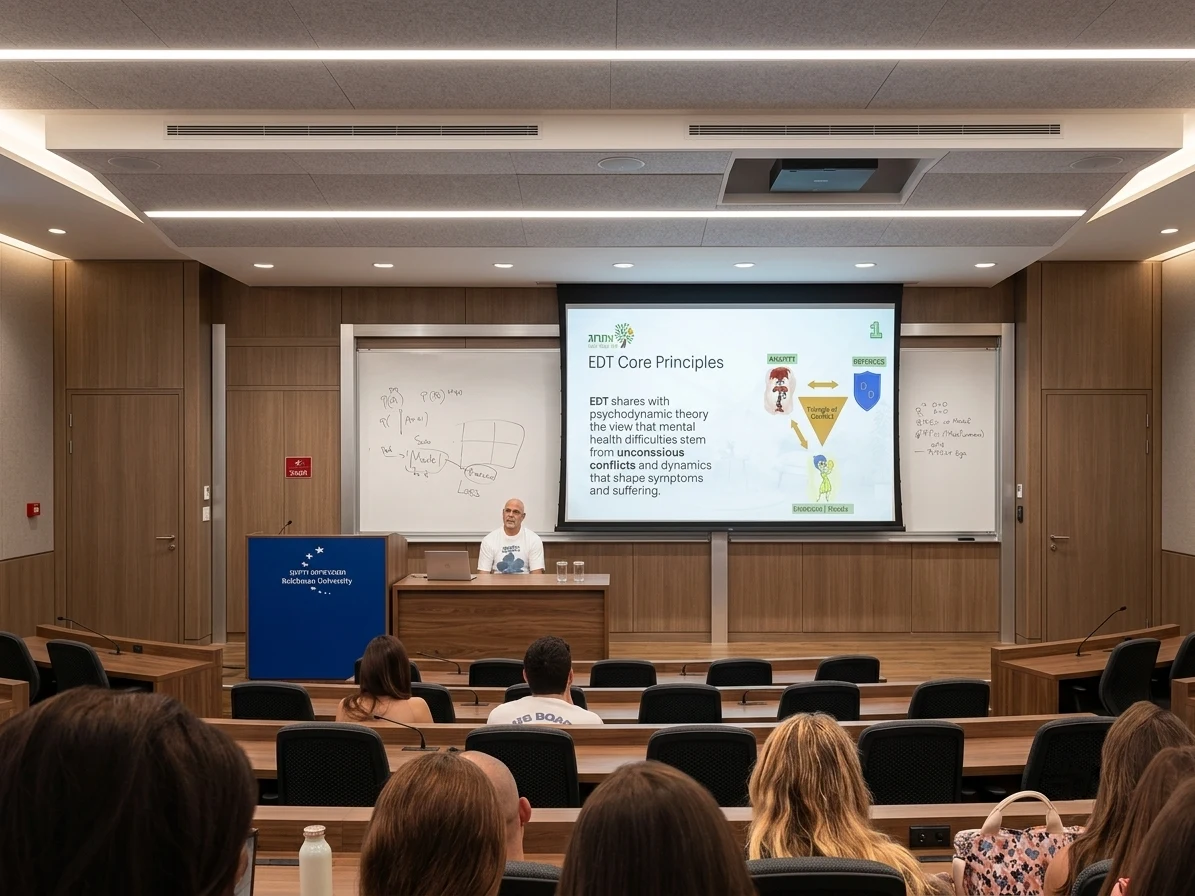
In a five-hour international seminar on Experiential Dynamic Therapy (EDT), with the participation of therapists from Israel and around the world, we engaged with one of the most complex and vivid issues in psychotherapy: how to work experientially with anger and aggression when they appear within the therapeutic context itself.
Roots of the Approach and Working Principles
The seminar opened by presenting the roots of the EDT approach from the work of Habib Davanloo and David Malan, and the development of the field through the work of key therapists including Dr. Ferruccio Osimo, Diana Fosha, and Leigh McCullough. From this tradition, several core principles common to experiential-dynamic approaches were presented: active and focused work, constant attention to anxiety and defenses, creating an active therapeutic alliance, and inviting the patient to a more direct contact with their emotions within their window of tolerance.
Anger as an Adaptive Emotion
A central part of the seminar was dedicated to anger as an adaptive emotion. Anger is not merely perceived as a problem to be regulated or a behavior to be stopped, but also as a vital emotional system connected to self-defense, setting boundaries, a sense of self-worth, and the ability to act in the world. However, when throughout development anger is met with rejection, humiliation, fear, or punishment, the patient may learn to turn it against themselves, avoid it, or express it in symptomatic and dysregulated ways.
Learning from Clinical Video Segments: When Anger Enters the Therapy Room
Through video segments from real therapy sessions, we examined the work in moments when anger does not remain just a “story about other people”, but appears directly in the relationship between the patient and the therapist:
- Regulation and Connection in Moments of Crisis: In one segment, during the processing of an early and humiliating experience, the patient suddenly experiences the therapist as not listening to them and directs anger towards them. Instead of viewing this as an interruption to the process, we explored the possibility of treating this moment as live therapeutic material: identifying the rise in anxiety, clarifying at whom the emotion is directed, regulating the intensity of the work, and continuing from within a connection that is not broken by the anger.
- Past and Present in the Therapeutic Encounter: Another segment illustrated an even more complex situation, where the patient enters the session angry at the therapist and experiences them as wanting to distance themselves. The work allowed for connecting the current experience in the relationship to a deeper history of rejection, undesirability, and injury. The discussion that developed around the segment emphasized a central principle in EDT: the therapist is not merely an outside observer of the emotion; they are part of the interpersonal field where the emotion arises, and they must track their own reactions, regulate themselves, and examine how they affect what is happening in the room.
The Power of the Real Relationship
Dr. Ferruccio Osimo, who accompanied the seminar, expanded the discussion around the importance of the Real Relationship – the actual connection between two people within therapy. Alongside transference, defenses, and early patterns, there is always a real reality of an encounter. The therapist’s ability to remain present, not be frightened by anger, take responsibility when a repair is needed, and at the same time not lose their boundaries and therapeutic stance – can turn a moment of rupture into a significant opportunity for change.
Clinical Precision: Between Technique and a Human Encounter
The discussion with the participants engaged with delicate clinical questions faced by every therapist:
- How do we know when to deepen the emotion and when to relieve pressure?
- How do we identify that we have crossed the patient’s window of tolerance?
- What is the difference between an experiential expression of anger and an enactment?
- How do we allow the patient to simultaneously experience anger, love, a need for connection, and guilt – without reducing the emotional complexity to a single emotion?
One of the central conclusions of the seminar was that working with intense emotions is not measured by how hard the therapist “pushes” the patient, but by the precision with which they know how to navigate between deepening and regulating, between challenge and empathy, and between technique and a genuine human encounter. This is also one of the core qualities of the EDT approach: the possibility to use what is happening right now between the therapist and the patient to help emotional patterns, which in the past led to anxiety, symptoms, or distancing from connection, take a new shape within a relationship where one can feel, think, and stay together.