

On Professional Humility, Active Integration, and Lessons Learned from a Patient with Bipolar Disorder

By: Yoram Reuveni, MSW
Co-Founder and Director of EDT Core
There were moments in therapy when I felt we were doing excellent work. The patient managed to emerge from a severe depression, return to work, exercise, socialize, and feel vital once again. A significant shift was also evident within the therapy room: less helplessness, a greater capacity to tolerate affect, and increased initiative and independence.
Then, after a while, severe depression hit again.
And again we worked, and again there was improvement.
After three such cycles, I began asking myself a troubling question: is it possible that I am so focused on the success of the therapy that I am missing something crucial in the broader picture?
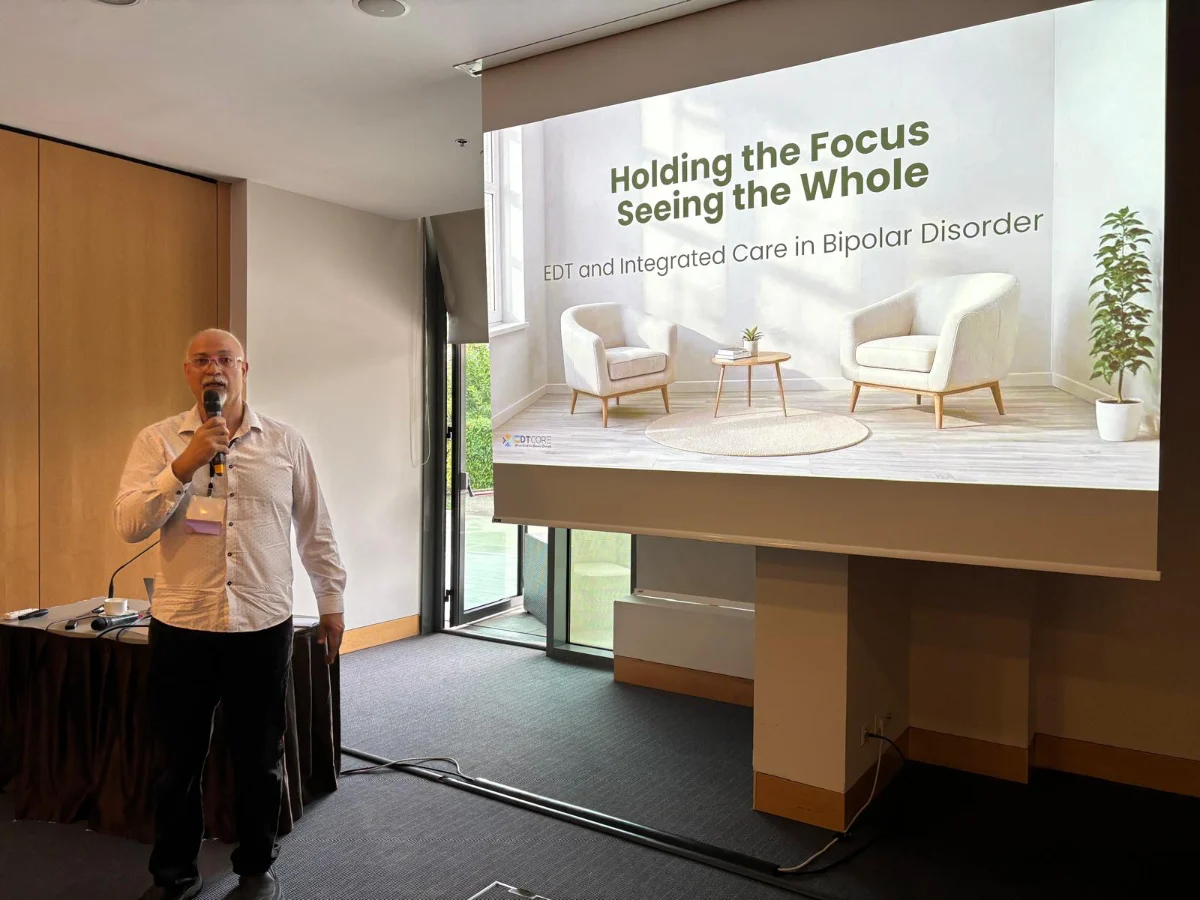
This was one of the questions I brought with me to the 12th International Conference of the IEDTA (International Experiential Dynamic Therapy Association), which took place in October 2026 in Dubrovnik, Croatia.
At the conference, I had the privilege of presenting alongside Dr. Ron Albucher, a psychiatrist, psychotherapist, and the president of the IEDTA, on the integration of Experiential Dynamic Psychotherapy (EDT) with psychiatry and pharmacotherapy.
It was a profoundly meaningful professional experience. Following the presentation, psychiatrists and psychotherapists approached us to share how vital this topic is to their own practice, expressing appreciation for our emphasis on the need to see the patient beyond the scope of our specific therapeutic model.

I would like to share the two cases we presented, along with two insights that have since become core principles in my clinical work.
Two Patients, Two Paths to Integration
Dr. Albucher opened with the case of a patient who had suffered for many years from significant anxiety, alongside additional difficulties and a history of alcohol and substance abuse.
Although this was a patient who could potentially benefit from focused dynamic therapy, Dr. Albucher chose not to initiate intensive emotional work right away.
During the first three months, treatment focused on pharmacological stabilization and supportive psychotherapy. Once the patient had achieved sufficient clinical stability and was better able to tolerate the anxiety associated with emotional exploration, the therapist began focused ISTDP work.
As treatment progressed, Dr. Albucher conducted deep and meaningful therapeutic work, helping the patient move beyond his defenses, regulate his anxiety, and gain access to core emotions. As the patient became more emotionally engaged and his clinical condition continued to improve, his medication was gradually tapered under psychiatric supervision. The outcome was highly favorable, reflecting the contribution of both pharmacological stabilization and focused experiential dynamic psychotherapy.
I reflected on the meaning of this case: sometimes, it is precisely the decision to hold back on focused emotional work that allows us to conduct it more effectively later on.
In the second part of the presentation, which I titled “Holding the Focus, Seeing the Whole”, I presented a very different case.
My patient, a man in his fifties with bipolar disorder, has been in therapy with me for about ten years. Over the years, we witnessed significant progress in his ability to work, develop relationships, and manage his life.
However, over the past year, recurrent fluctuations emerged, shifting between severe depression and periods of recovery and surging energy.
When he was depressed, I saw a helpless individual in the room, at times almost paralyzed in his capacity to take initiative or make decisions. Through our dynamic work, we identified defenses of withdrawal, dependence, and passivity. Underneath these, we encountered anxiety, anger, sadness, and a longing for closeness.
Through gentle work with affect, anxiety, and defenses, we managed to bring about a change. The patient became more present, more connected to himself, and better equipped to take action.
But over time, I began to notice something else.
When he emerged from depression, he didn’t just return to life; at times, he virtually charged into it. More work, more activity, more social gatherings, more plans. His confidence surged, his energy expanded, and his sleep patterns shifted.
What initially appeared to be a recovery often turned out to be the onset of hypomania.
And I realized that I needed to reframe the question I was asking.
Instead of focusing solely on ‘how do I help him emerge from depression?’, I began asking, ‘how do I help him remain stable once he does?’
I started diving deeper into bipolar disorder and exploring additional modalities, particularly IPSRT (Interpersonal and Social Rhythm Therapy)—an approach centered on the link between mood, sleep, activity, and social rhythms. I learned just how crucial it is to track not only shifts in affect, but also changes in energy levels, sleep duration, and the overall load the patient takes upon himself.
The biopsychosocial model took on a highly practical meaning for me. While emotional therapy was essential, medication, sleep, work, family, and daily routine were equally vital parts of the narrative.
And then, I uncovered an additional challenge.
Although the patient was under psychiatric care, the psychiatrist primarily saw him only when he was already in a severe depression. In that state, he struggled to articulate what he had experienced in the preceding weeks, to assert himself, or to voice his needs. While family members tried to help, they sometimes spoke on his behalf.
I, having engaged with him continuously over time, held a different clinical picture. I could observe the transitions, the early warning signs, and the stark contrast between who he was during depression versus periods of heightened activity.
Suddenly, it became clear to me: there was psychotherapy, there was psychiatry, and there was an involved family—but there was not necessarily a shared therapeutic overview.
I decided to take action.
I met with the patient’s sisters to help them identify early warning signs and understand how to offer support without creating additional pressure. I contacted the psychiatrist and shared the timeline of changes I had observed over time. It was equally vital to me to safeguard the patient’s agency and ensure his voice was heard within his care system.
This broader understanding allowed us to begin addressing not just the acute episodes themselves, but also the transitions between them and the ways to maintain stability.
One of the most meaningful moments for me was when the patient began to feel well again, but this time, he chose not to rush back to work. Instead, he admitted himself to a step-down stabilization facility to learn how to live better with his illness and regulate the demands of his life.
It is still too early to determine the long-term outcome. However, in my view, a crucial shift has taken place: he began to understand that recovery is not just about returning to do more, but also about knowing when to slow down.
Two Insights I Carried from the Process
This case crystallized two principles for me, which became the central message of my presentation.
The first is Professional Humility.
I believe deeply in EDT and the power of therapy focused on affect, anxiety, and defenses. However, no single model can capture the full complexity of a human being.
Professional humility means recognizing what our model allows us to see, while remaining equally alert to what it does not allow us to see. In this case, I needed to broaden my knowledge and draw upon psychiatric, behavioral, and systemic thinking as well.
The second principle is Active Integration.
It is not enough for us to merely recommend that a patient see a psychiatrist, or to simply be aware that they are receiving concurrent treatment.
For true integration to occur, someone must take responsibility for cultivating it: ensuring that information flows, that professionals understand one another, that the patient is an active partner, and that the various components of treatment work in synergy.
This is not necessarily the sole responsibility of the psychotherapist, but when we identify a missing link, it is crucial that we act to facilitate it—always with the patient’s consent and with strict adherence to confidentiality.
Professional humility helps us identify what is missing. Active integration allows us to ensure that the missing component is actually addressed.
Three Takeaways for the Consulting Room
I thought it would be useful to conclude with three simple questions that I suggest asking ourselves from time to time, particularly in complex treatments:
1. What am I potentially missing?
When a patient is failing to progress as expected, it is worth asking whether my formulation—as accurate as it may be—presents only a fraction of the picture. Is there a medical, psychiatric, familial, or environmental factor that I have not given sufficient weight to?
2. Am I looking only at the session, or also at what happens between sessions?
At times, what appears to be an improvement within the consultation room takes on a completely different meaning when evaluating sleep, energy levels, activity, and functioning over time. This is especially vital in mood disorders, but remains highly relevant to other clinical conditions as well.
3. Who holds the whole picture—and who is responsible for connecting its pieces?
If the patient is seeing multiple professionals, are they truly coordinated? Does each one possess vital information that the others are unaware of? And is there a need for someone to take active responsibility for bridging the gaps between them?
These may seem like minor questions, but they have the potential to completely shift the trajectory of the treatment.

I returned from Dubrovnik with a deep sense of fulfillment regarding the presentation and the dialogues it sparked, and above all, with an idea that I wish to continue sharing with my colleagues. As we specialize in a particular therapeutic modality, we learn to observe things through it that we could not see before. This is one of the greatest gifts of professional specialization. However, perhaps a vital part of our evolution as clinicians is learning when to broaden our gaze. Not to abandon focus and depth, but to integrate them within a wider responsibility toward the human being sitting across from us. Because ultimately, success does not belong to the therapeutic method. Success belongs to the patient. And that, for me, is the core essence of Holding the Focus, Seeing the Whole.
Yoram Reuveni, MSW
Psychotherapist and Certified EDT Teacher.
Founder and Director of EDT Core.
Based on a joint presentation with Dr. Ron Albucher at the IEDTA Conference, Dubrovnik, October 2026. The clinical case details are presented in a concise manner designed to protect patient confidentiality.